
How Far Should Palm Trees Be From a Pool? Safe Distances, Roots and Best Choices
Key Takeaways
- As a rough guide, keep small palms 1.2 to 1.8 m from the water's edge, medium palms 1.8 to 3 m and large palms 3 to 4.5 m or more.
- Palm roots are fibrous and rarely crack a sound pool shell, but they can lift paving, coping and shallow pipes.
- Plumbing runs, the equipment pad and the pool barrier need their own clearance, not just the pool edge.
- Compact, low-litter palms such as pygmy date and lady palms suit tight pool areas best.
- Ponds and lined water features need more distance than a solid concrete pool.
- If an existing palm is too close, compare its mature size with the space before pruning roots or removing it.
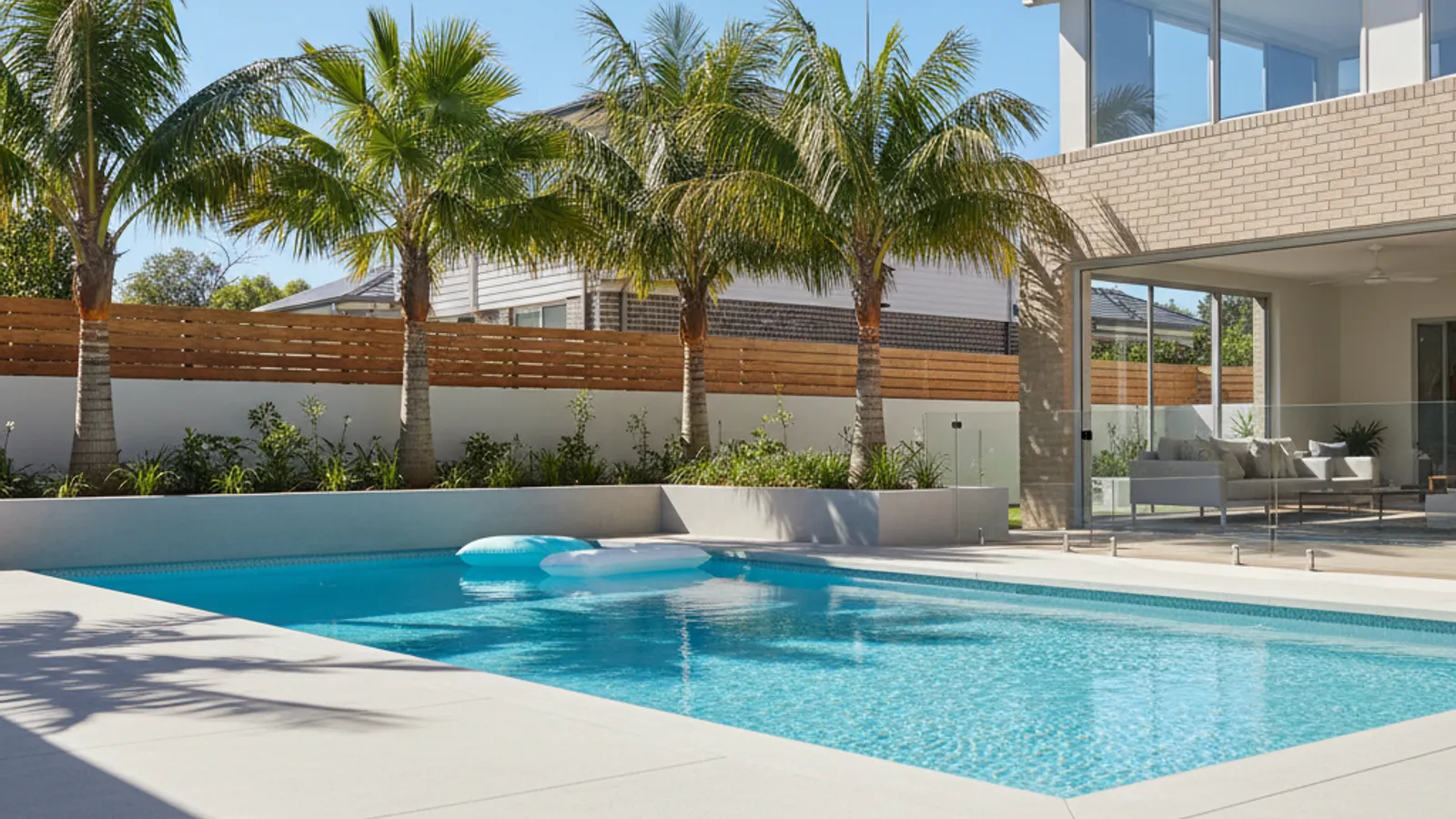
Palm trees and swimming pools are a natural match. They frame the water, add a resort feel and cast some welcome shade. The question most homeowners ask before planting is simple: how far away should the palm go?
As a rough guide, keep small palms about 1.2 to 1.8 m (4 to 6 ft) from the water’s edge, medium single-trunk palms about 1.8 to 3 m (6 to 10 ft) and large palms 3 to 4.5 m (10 to 15 ft) or more. The right number for your yard also depends on the palm species, the type of pool, the paving and where the pool plumbing runs.
Getting the distance right protects the pool surround, the pipes and the palm itself, and saves you from costly repairs or removal later.
Recommended Distance for Planting Palm Trees Near a Pool
The closer you plant, the more careful you need to be about species, root behaviour and future growth. Use these ranges as a starting point, then adjust for the site.
General Distance Rules of Thumb
| Palm Size | Example Species | Distance From Water’s Edge | Distance From Plumbing |
|---|---|---|---|
| Small or clumping | Pygmy date, lady palm | About 1.2 to 1.8 m | About 1 m or more |
| Medium single trunk | Foxtail, smaller fan palms | About 1.8 to 3 m | About 1.5 to 2.5 m |
| Large or tall canopy | Canary Island date, tall Washingtonia | About 3 to 4.5 m or more | About 2.5 to 3 m or more |
These figures are general guidance, not a building rule. If you do not know where the plumbing runs, assume the pipes travel in fairly straight lines from the skimmer and returns to the equipment pad, and keep trunks well clear of that path.
How Pool Type and Layout Affect Distance
- Concrete pools. The shell is thick and reinforced, so cracking from palm roots is uncommon. Focus on protecting the coping, paving and plumbing.
- Fibreglass and vinyl liner pools. The walls rely more on the surrounding backfill. Give palms extra space, especially large species.
- Above-ground pools. Keep trunks and roots far enough away that they cannot press on the wall or supports, and leave room to walk around for inspections.
- Narrow surrounds and small yards. Even small palms can feel cramped at the minimum distance. Leave working room for resurfacing, coping repairs and equipment replacement.
Shade structures and pergolas also limit how tall and how close a palm can be, because fronds that rub on beams or roofing cause damage and are hard to maintain.
Do Palm Tree Roots Damage Pools, Pipes or Decking?
Palm roots rarely crack a sound pool shell the way some large broadleaf tree roots can. They can still lift paving, disturb coping and crowd shallow pipes when a palm is planted too close. The main risk is a cramped root zone, not roots attacking the pool.
Palm Root Systems Explained
Palms grow a mass of fibrous roots from the base of the trunk rather than a few thick woody roots. Most of these roots stay in the upper layers of soil and spread outwards, and the most active roots sit close to the trunk.
Because palm roots do not keep thickening the way woody roots do, they are less likely to heave heavy structures. Our guide to whether palm tree roots cause damage explains the difference in more detail. Roots do follow moisture, so damp soil around a leak, a drain or an overwatered bed can draw them in.
Potential Risks to Pool Shells and Plumbing
- Paving and coping. Roots can lift pavers or create small humps in thin slabs when planted very close.
- Plumbing and drainage. Over many years roots can crowd shallow pipes, and in rare cases they can enter a pipe through an existing crack or loose joint.
- Equipment pads. Roots can undercut a thin pad and tilt the pump or filter.
Most serious problems involve a large palm planted very close, combined with thin concrete, shallow pipes or existing cracks.
Signs a Palm Is Too Close to Your Pool
- Raised or uneven pavers near the trunk or along a clear root path
- New cracks or sinking in the surround that run toward the palm
- Coping that separates or tilts on the side nearest the palm
- Damp patches or soft ground between the palm and the equipment pad
- Skimmer baskets that fill quickly with fronds, fruit or seed
If you notice more than one of these signs, have a pool technician or arborist look at the area.
How Palm Size and Species Affect the Ideal Distance
The ideal setback depends heavily on how big the palm will be when mature, not how big it is in the nursery pot.
Small and Clumping Palms
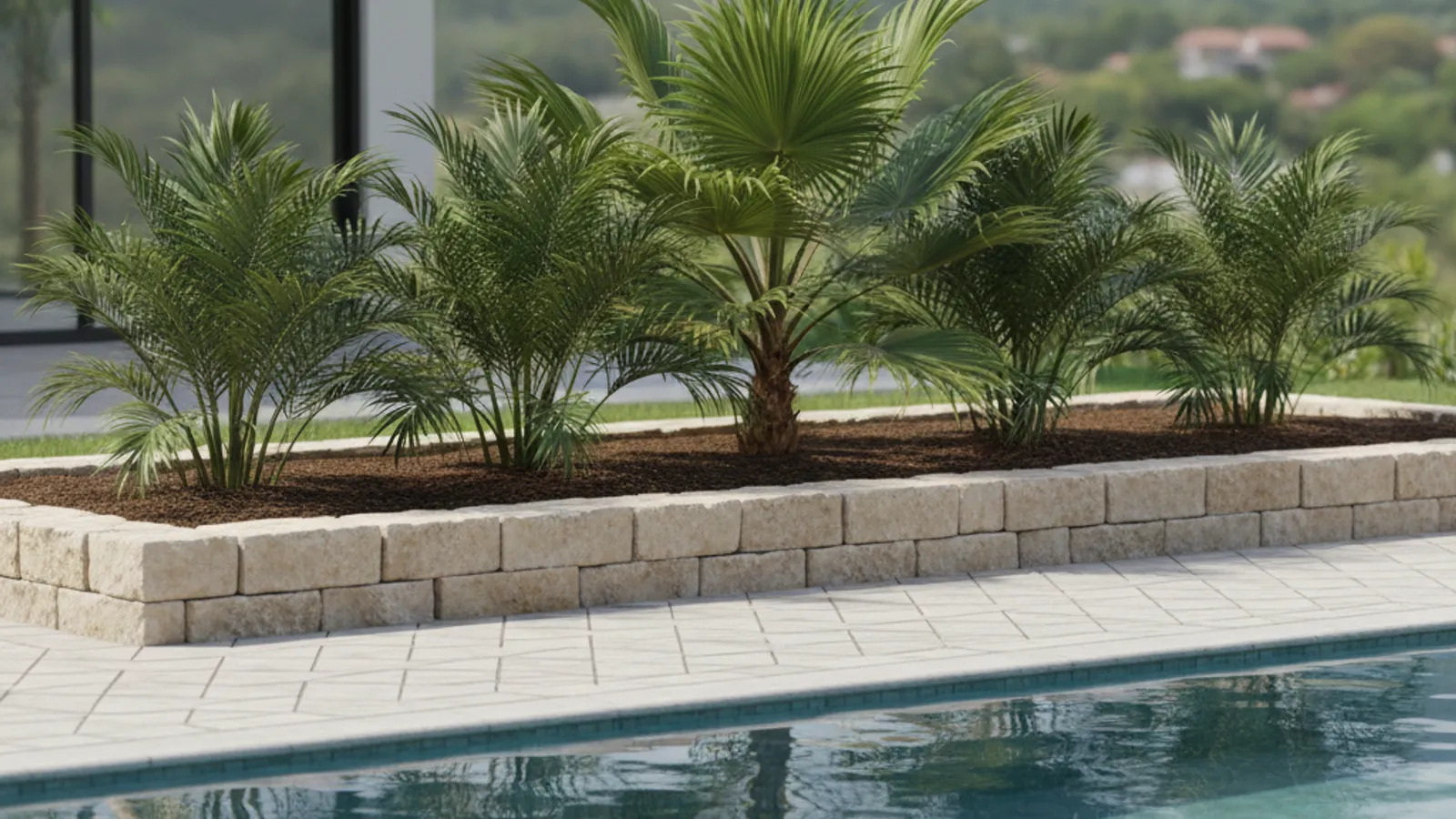
Pygmy date palms, lady palms and other compact species have lighter root systems and stay short, which suits tight pool yards.
- Plant about 1.2 to 1.8 m from the water’s edge if the paving is sound and the plumbing is reasonably deep.
- Leave about 1 m between the clump and any fence or wall for airflow and pruning.
- Avoid planting directly over known plumbing runs, even when the distance to the pool looks fine.
Medium Single-Trunk Palms
Foxtail palms and medium fan palms create a more dramatic look and some shade, but need more room.
- Keep about 1.8 to 3 m between the trunk and the water’s edge.
- Check the mature crown spread so the canopy does not hang over the whole pool.
- Allow vertical clearance from roofs, shade sails and power lines, because mature fronds are long and heavy.
These palms work well at pool corners or just outside the main lounging area, where they frame the view without dropping everything into the water.
Large or Aggressive Species to Keep Farther Away
Canary Island date palms, very tall Washingtonia fan palms and similar large species can overpower a pool area.
- Place them at least 3 to 4.5 m or more from the water’s edge.
- Avoid them altogether in small pool yards or near thin paving and light retaining walls.
- Watch for spiny frond bases and heavy fruit over walkways.
Queen palms are common in Melbourne gardens, but they drop a lot of fruit and fronds. Treat them as a medium to large palm and keep them well back from the water.
Best Palm Trees to Plant Beside a Pool
The best palms for a pool area share three traits: compact roots, manageable height and little litter. These let you plant closer without constant cleaning or repairs.
Low-Litter, Pool-Friendly Palms
| Palm | Why It Suits a Pool | Typical Placement |
|---|---|---|
| Pygmy date palm | Small, tidy and slow growing | Close end of the small palm range |
| Lady palm | Dense screening foliage, small root zone | Close end of the small palm range |
| Foxtail palm | Clean trunk, sheds old fronds neatly | Medium palm range |
| Bangalow palm | Slender trunk, suits sheltered spots | Medium palm range, away from the water’s edge |
Even with tidy species, leave enough space to walk behind them for pruning and pool maintenance.
Palms That Create Shade Without Messing Up the Pool
If you want shade, think about where the shadow falls rather than putting the palm right at the water.
- Plant shade palms a little farther back so the shadow lands on loungers and the outdoor table rather than over the deep end.
- Medium palms about 2.5 to 3.5 m from the pool can shade one side of the surround.
- Position palms so the prevailing wind carries litter away from the water.
- Avoid dense, low canopies over steps or entry points where visibility matters.
In Melbourne, palms placed to the north or west of a seating area catch the strongest afternoon sun.
Where to Plant Palm Trees in Relation to Pool Features
It helps to think about each pool feature separately: the water’s edge, the surround, the barrier and the buried services. Each needs its own clearance.
Distance From the Pool Edge, Coping and Paving
- Small palms. Measure 1.2 to 1.8 m from the water’s edge and make sure that still leaves clear paving between the trunk and the coping.
- Medium palms. Start at 1.8 to 3 m, leaving room for chairs and a walkway between the trunk and the pool.
- Large palms. Place them beyond the edge of the paving where possible, so their roots sit under garden beds rather than slabs.
If you might extend or resurface the paving later, keep trunks toward the garden so trades can reach every side of the pool.
Clearance From Fences, Walls and the Pool Barrier
- Fences and boundary walls. Leave space so the trunk does not lean on or push against the structure as it thickens, and so fronds do not scrape finishes in the wind.
- The pool barrier. In Victoria, plants, pots and trunks near the pool fence must not give a child something to climb. Check the pool safety barrier guidance from the Building and Plumbing Commission before planting near the fence, and keep palms that will grow climbable trunks or clumps clear of the non-climbable zone.
Palms squeezed against walls also concentrate their roots in a small soil volume, which raises the chance of lifting nearby pavers and edging.
Keeping Clear of Underground Lines and Equipment
| Feature | Suggested Clearance From Trunk | Main Reason |
|---|---|---|
| Water’s edge and coping | Varies by size, at least 1.2 m | Coping and surround stress |
| Skimmer and plumbing runs | About 1 to 3 m depending on palm size | Pipe protection |
| Equipment pad | About 1.5 m or more | Service access and root lift |
| Fence or pool barrier | Clear of the climbable zone | Child safety and structure |
- Keep trunks off the likely path of the skimmer, return and cleaner lines.
- Leave room around the pump, filter, heater and controls for servicing.
- Avoid planting over electrical conduits or gas lines.
If you are not sure where services run, check the original pool plans or use a service locating company before you dig.
Can You Plant Palm Trees Next to a Pond or Water Feature?
Yes, but give them a little more room than you would beside a concrete pool. Pond liners and stacked stone edges are far less rigid than a pool shell.
Differences Between Pools, Ponds and Water Features
- Concrete pool shells are thick, reinforced and backfilled for stability, so they resist roots well.
- Lined ponds and decorative basins rely on flexible liners or thin masonry that roots and moving soil can push, puncture or displace.
- Natural-style water features hide liners under rock and soil, so small soil movement can shift the edging.
Protecting Liners and Edging From Roots
- Increase the setback slightly beyond the pool distances above.
- Install a root barrier between the palm and the pond to steer roots away from the liner.
- Choose small, clumping species rather than heavy, tall palms near lightweight walls.
A palm in a large container can give the look you want beside a water feature without putting the liner at risk.
How to Decide if an Existing Palm Is Too Close to Your Pool
Many homeowners inherit palms that were planted without much thought. You can still work out whether yours is fine or needs action.
Assessing Current Distance and Risk
- Measure from the centre of the trunk to the water’s edge and to the nearest coping or paving.
- Compare that with the range for the palm’s mature size, not its current size.
- Look up the species’ mature height and crown spread.
- Check for lifting pavers, new cracks or damp ground.
- Decide whether to keep and monitor, manage the roots, or relocate or remove.
A young palm of a very large species can become a problem quickly if it is already closer than its mature size allows.
When Root Pruning or Barriers Can Help
- Light root pruning on one side may be possible when an arborist who understands palms does the work.
- A buried root barrier between the palm and the pool or plumbing can direct new roots away from the problem area.
Aggressive root cutting can destabilise a palm or starve it of water. That is a real safety risk for a tall palm in strong wind.
When to Remove or Relocate a Palm Tree
Removal or relocation makes sense when:
- The trunk is much closer than its mature size allows.
- Damage to the paving, coping or plumbing is clearly linked to the palm.
- The canopy already interferes with roofs, shade structures or power lines near the pool.
Small palms can often be transplanted. Large palms are heavy and hard to reach in a fenced pool yard, so they usually need a professional crew. Our palm tree removal cost calculator gives a rough price based on height and access, and it is worth checking whether you can remove the palm without council approval before you book anyone.
Basic Care Tips for Poolside Palms
Pool surrounds are harsh spots, with splashing water, reflected heat and foot traffic. A few habits keep poolside palms healthy and their roots balanced.
Water, Chlorine and Salt Exposure
Most established palms cope with occasional splash from a chlorinated pool, especially where rain and irrigation dilute it.
- Planting a little farther from the water limits chemicals building up in the root zone.
- Saltwater pools can stress palms in sandy or poorly drained soil, so extra distance and a deep watering now and then help.
- Never direct filter backwash or strong wastewater straight into a palm bed.
What Not to Do With a Palm Near a Pool
- Do not compact the soil over the root zone with machinery or stacked pavers during pool works.
- Do not bury the trunk or raise the soil level around an established palm, which can rot the base.
- Do not store sand, stone or building materials over the roots for long periods.
- Do not aim strong cleaners or a pressure washer at the soil around the trunk.
Frequently Asked Questions
Is it safe to plant palm trees right next to the pool coping?
It is rarely a good idea. Even small palms are best kept at least 1.2 m from the water's edge so roots have space and the coping and paving can be repaired without disturbing the palm.
How far apart should palm trees be from each other around a pool?
Space palms by their mature crown spread. Small palms often sit about 1 to 1.5 m apart, while medium single-trunk palms usually need 2.5 to 4 m so canopies and root zones do not crowd each other.
Can palm roots break concrete pool decks?
They can lift or crack thin slabs, pavers and poorly compacted paving when planted very close. Reinforced concrete on good compaction is much less likely to be affected.
Do palm trees attract pests or drop debris into the pool?
Many palms drop fronds, flowers and fruit, and fruiting species can attract birds and insects. Choosing tidy species and planting them where the canopy does not hang over the water keeps litter down.
Are palm trees hard to dig up if I planted them too close to the pool?
Small palms can often be dug up and moved. Large palms are heavy, hard to access in a pool yard and usually need a professional crew with the right equipment.
Can I plant palms in large pots near the pool instead?
Yes. Containers keep roots away from paving and plumbing and let you place palms closer to the water. Use a heavy, wide pot and keep it out of the pool barrier's climbable zone.
Will palm tree roots seek out pool water if there is a leak?
Roots grow toward moist soil, so a slow leak can draw them toward pipes and fittings. Fixing leaks promptly removes that attraction and protects both the pool and the palm.
Final Verdict: How Far Should Your Palm Be From the Pool?
For most homes, keep small palms about 1.2 to 1.8 m from the water’s edge, medium single-trunk palms about 1.8 to 3 m and large palms 3 to 4.5 m or more. Then adjust for the pool type, the paving and where the plumbing and equipment sit.
Choose compact, low-litter species, keep palms clear of the pool barrier’s climbable zone and check inherited palms against their mature size. When in doubt, a little more distance gives the roots room to grow and makes pool maintenance far easier.