
Do Palm Tree Roots Cause Damage? Concrete, Foundations, Pipes, Driveways and More
Key Takeaways
- Palm roots can damage property, but foundation damage is less common than many fear.
- Palm roots are fibrous and do not keep thickening like woody roots.
- Paving, driveways and pool surrounds are the most common trouble spots.
- Roots enter pipes through existing cracks or bad joints, not sound pipes.
- In clay soils, moisture changes can move foundations without roots touching them.
- Find the real cause before cutting roots or removing the palm.
Palm trees can transform a garden, driveway or backyard, but homeowners often worry about what is happening underneath the ground.
Can palm tree roots crack concrete? Can they damage a house foundation, block sewer pipes, lift paving or interfere with a swimming pool?
The short answer is that palm tree roots can cause property damage, but serious damage to a sound foundation is generally less likely than many homeowners assume. Palms have a different root system from many broadleaf trees, and the type of damage depends on the species, soil conditions, planting location and the condition of nearby structures.
Understanding how palm roots grow can help you decide whether an existing palm is a genuine problem, how far away to plant a new one, and what to do if roots are already affecting your property.
How Do Palm Tree Roots Grow?
Unlike many trees that develop large, woody roots that continue increasing in thickness, palms produce numerous adventitious roots from a root-initiation zone at the base of the trunk. These roots spread through the surrounding soil to absorb water and nutrients and to anchor the palm.
Palm roots are generally fibrous and relatively uniform in diameter. They do not develop the same type of continuous secondary thickening found in the woody roots of many conventional trees. However, the palm can continue producing new roots, and its overall root system can spread considerably as the plant matures.
According to the University of Florida’s palm morphology and anatomy guidance, roots emerge from the trunk’s root-initiation zone, and some species naturally develop visible root structures above the soil. This is not necessarily a sign that the palm is unhealthy or damaging nearby structures.
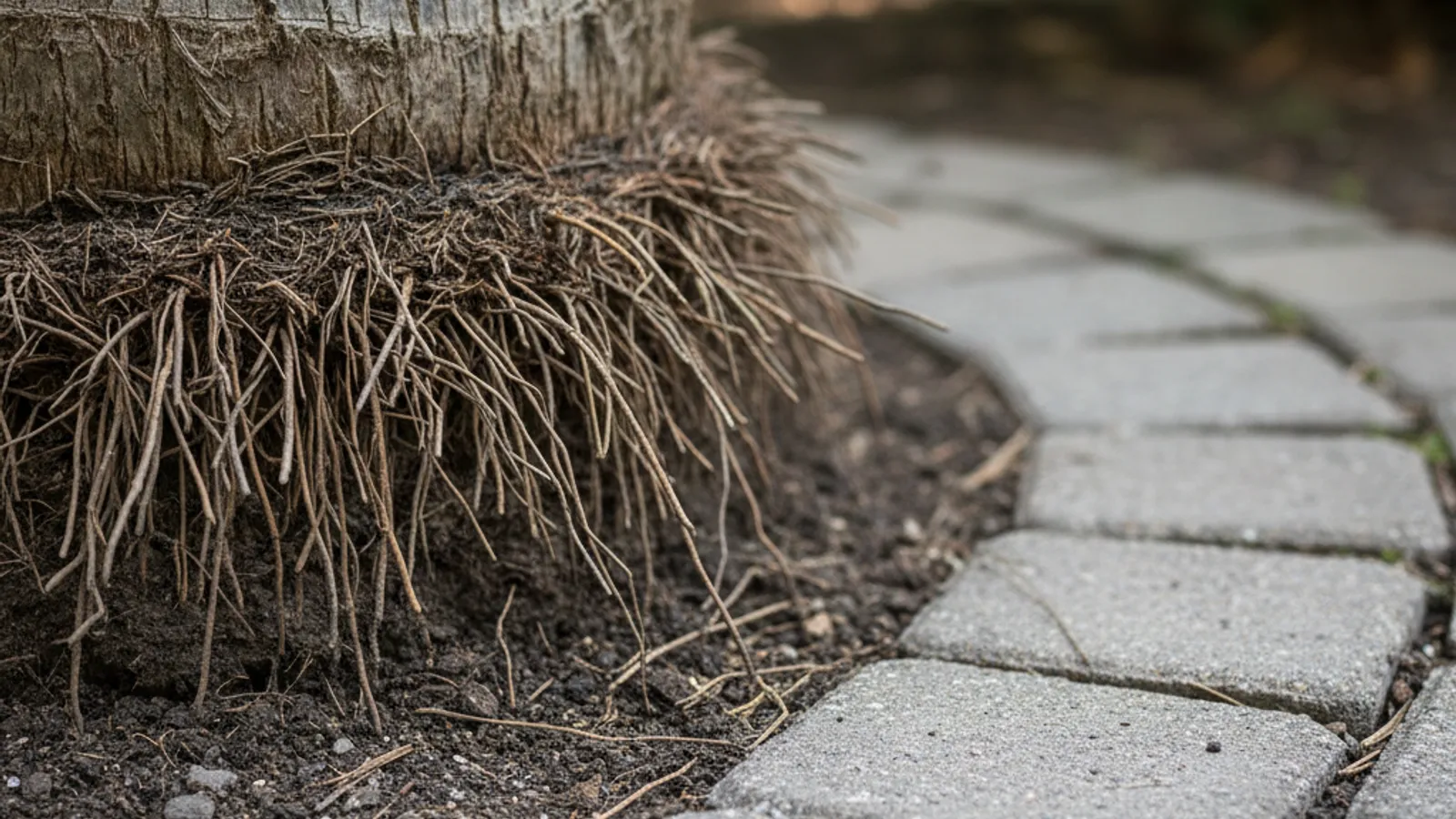
The important point is that palm roots are not completely harmless simply because they are fibrous. A dense root system can occupy space beneath paving, encounter underground services and interact with surrounding soil.
| Palm Roots | Many Broadleaf Tree Roots | |
|---|---|---|
| Root type | Numerous adventitious roots | Large woody roots |
| Thickness over time | Relatively uniform | Continue increasing in thickness |
| Where they start | Root-initiation zone at trunk base | Main root system below the trunk |
| Main property risk | Paving, tight spaces, pipes with defects | Lifting and cracking from thickening roots |
Can Palm Tree Roots Damage Concrete?
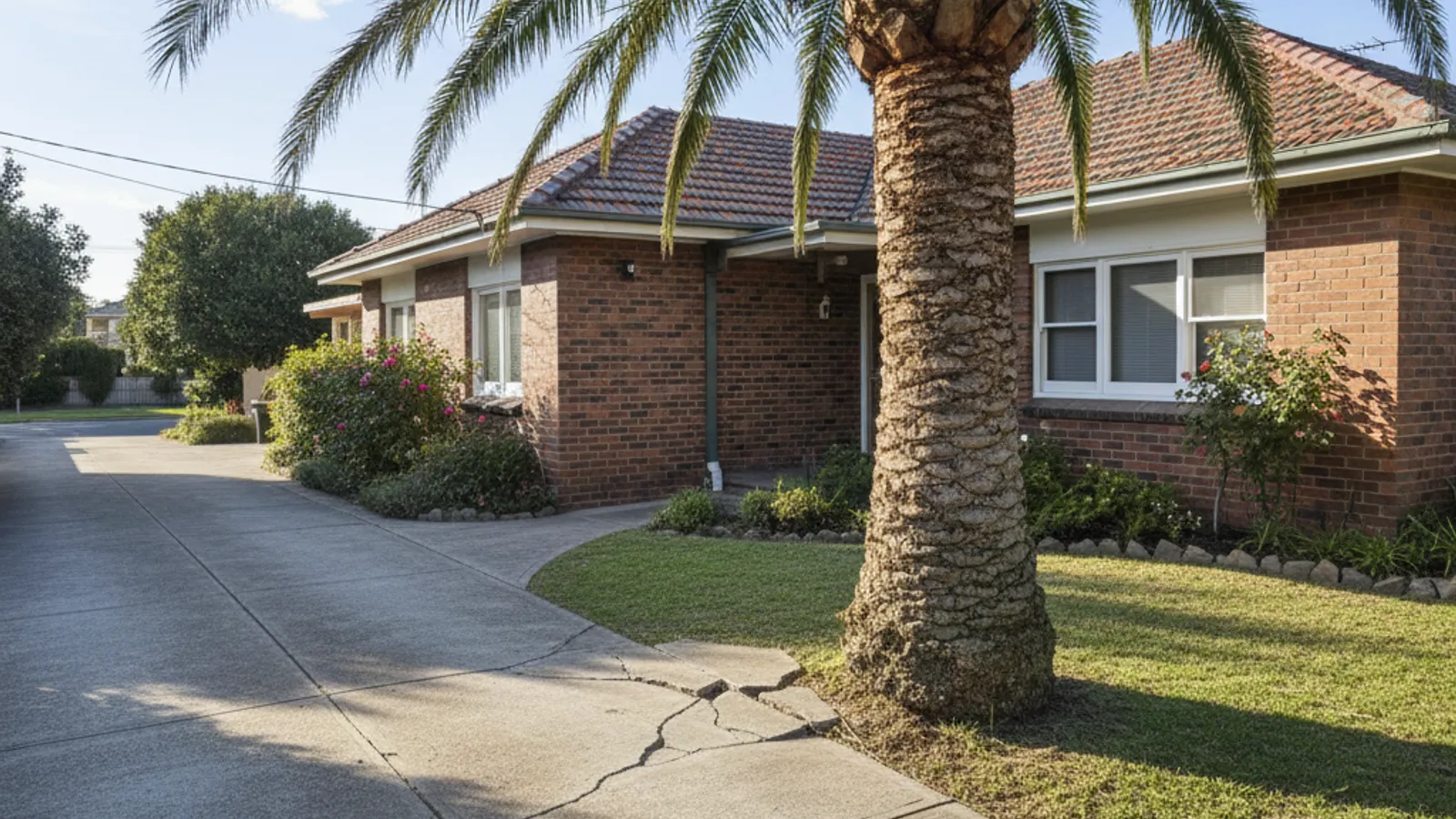
Yes, palm tree roots can contribute to damage around concrete surfaces, although the risk varies with the palm species and the construction.
The areas most worth checking include:
- Concrete driveways and parking areas
- Footpaths and garden walkways
- Patios and outdoor entertaining areas
- Concrete edging and garden borders
- Pool surrounds and paving
- Thin slabs and poorly supported concrete sections
Damage may develop when roots grow beneath a surface, displace soil or encounter a slab that has insufficient support. Existing cracks, poorly prepared ground and drainage problems can make a surface more vulnerable.
However, not every crack near a palm is caused by its roots. Concrete can crack because of shrinkage, temperature changes, ground settlement, poor installation or heavy loads. Roots can sometimes exploit an existing opening rather than create the original defect. Running bamboo behaves the same way, and our guide on what bamboo can grow through compares how concrete, asphalt and other materials hold up.
Can Palm Tree Roots Lift Concrete?
They can contribute to lifting or unevenness, particularly where paving is shallow, poorly supported or installed close to the trunk.
The mechanism is not necessarily the same as the familiar damage caused by large, continuously thickening woody roots. Palms produce many roots, and the interaction between the root mass, surrounding soil and hard surface can create problems where space is restricted.
If a concrete path begins to rise near a palm, look for other evidence before deciding what caused it. A visible root directly beneath a raised section is useful evidence, but an inspection may still be needed to determine whether the root, soil movement or a construction defect is responsible.
Can Palm Tree Roots Crack a Concrete Driveway?
A driveway can develop cracks, uneven sections or raised edges near a palm, especially when the tree was planted too close to the driveway or the concrete was laid over an inadequate base.
Vehicle loads can also expose weaknesses in a slab that was already poorly supported. If the driveway is cracking, check whether the damage follows a root’s path or appears across areas with no obvious root involvement.
Repairing the concrete without addressing the underlying cause may only provide a temporary solution. If roots or unstable ground remain beneath the slab, the problem may return.
Can Palm Tree Roots Damage a House Foundation?
Palm roots are generally less likely to directly fracture a sound concrete foundation than large, thickening woody roots, but foundation damage cannot be ruled out in every situation.
It is important to distinguish between two mechanisms:
- Direct physical interference: Roots encounter an existing weakness, opening or shallow structural element.
- Indirect soil movement: A tree changes soil moisture conditions, and the ground supporting a foundation moves or settles.
The second mechanism deserves particular attention in areas with moisture-sensitive clay soils.
Tree roots absorb water from the ground. Depending on the soil, climate, tree size and other site conditions, changes in soil moisture can contribute to shrinkage and uneven foundation movement. A building may then develop cracks even if roots have not physically broken through the concrete footing.
The Victorian Building Authority’s guidance on minimising foundation movement explains that trees can affect the moisture content of soil near buildings and that foundation problems can sometimes occur after a tree has been removed.
Nevertheless, it would be inaccurate to blame a nearby palm automatically for every wall crack or sticking door. Foundation movement can also result from drainage defects, leaking pipes, inadequate construction, changes in groundwater or other soil conditions.
How Close Can a Palm Tree Be to a House?
There is no single distance that is safe for every palm and every building.
A compact ornamental palm in a suitable planting bed presents a different situation from a mature, large palm planted beside a house on reactive clay. Foundation design, soil type, palm species, mature size, irrigation and underground services all influence the risk.
When choosing a planting location, consider the palm’s mature dimensions rather than its size when purchased. Allow room for its roots, trunk, canopy and maintenance access.
If you already have a mature palm close to your home and notice progressive wall cracks, uneven floors or doors that suddenly begin sticking, seek advice from a qualified building professional or structural engineer. An arborist can assess the tree, while an engineer can investigate possible foundation movement.
Can Palm Tree Roots Damage Underground Pipes?
Yes, palm roots can enter underground pipes if a suitable opening already exists, although they do not normally force their way through an intact, properly sealed pipe simply by growing.
Roots naturally grow toward areas where moisture and nutrients are available. A leaking pipe, defective joint or existing crack can create favourable conditions for root intrusion.
Once roots enter a damaged sewer or drainage line, they can grow inside it, collect debris and contribute to blockages. The pipe may eventually suffer further deterioration, particularly if the original defect is left untreated.
Older pipes with deteriorating joints may be more vulnerable than well-installed modern pipes with sound, watertight connections. However, the material alone does not guarantee that a pipe is safe from root intrusion.
Signs That Palm Roots May Be Affecting Pipes
Watch for recurring drain blockages, slow drainage, unusual wet patches in the garden, persistent sewage odours or unexplained drainage problems near a palm.
These symptoms are not proof of root damage. Grease, foreign objects, pipe deterioration and other plumbing faults can produce similar problems.
If blockages keep returning, ask a licensed plumber to inspect the line, potentially using a CCTV drain camera. This can help establish whether roots are present, where they have entered and whether the pipe itself is damaged.
In many cases, repairing or relining the defective pipe is more appropriate than immediately removing a healthy palm. The right approach depends on the location and severity of the defect and whether the tree is likely to create an ongoing conflict.
Can Palm Tree Roots Damage a Swimming Pool?
Palm trees can create problems around swimming pools, but the risk depends on the pool’s construction and the palm’s location.
Potential issues include:
- Raised or uneven poolside paving
- Cracked concrete edging
- Displaced pavers
- Root interference with nearby drainage
- Leaves, fruit and other debris entering the pool
- Restricted space around underground pool plumbing
A sound pool shell is different from the surrounding coping and paving. Damage to the surrounding hardscape does not automatically mean that roots have penetrated the pool structure.
If you notice cracks around a pool, water loss, shifting coping or unexplained changes in the surrounding ground, have the pool and its plumbing assessed. A pool leak, defective installation, soil settlement and root-related problems require different solutions.
University of Florida landscape guidance notes that palms can often be planted closer to swimming pools than trees with more aggressive root systems. This is a useful general distinction, not a guarantee that every palm can safely be planted beside every pool.
If you are still planning the planting, our guide on how far palm trees should be from a pool gives rough setback distances by palm size and pool feature.
Can Palm Tree Roots Damage Walls, Fences and Retaining Walls?
They can contribute to problems when planted in restricted spaces or close to vulnerable structures.
Garden walls, lightweight fences, retaining walls and decorative edging may be affected by changes in the surrounding soil, root growth or inadequate foundations. The risk is not identical for every structure: a properly engineered retaining wall is different from a shallow garden border.
Look for new gaps, leaning sections, displaced edging or changes in ground level around the palm.
Do not assume that cutting every visible root will solve the problem. Roots help anchor the palm, and removing important roots can affect its stability. Before excavating beside a mature palm or cutting substantial roots, seek advice from a qualified arborist.
Do Palm Tree Roots Damage Lawns, Garden Beds or Nearby Plants?
Palm roots can compete with nearby plants for water, nutrients and growing space. A dense root network may make it harder to establish some lawns, shrubs or small garden plants close to the trunk.
This is generally a competition issue rather than structural damage.
The outcome depends on the palm species, the amount of available soil, irrigation, sunlight and the plants growing nearby. Ground covers and other shallow-rooted plants may work in some locations, while plants that need deep, undisturbed soil may struggle.
Avoid piling excessive soil over the palm’s root-initiation zone or digging aggressively around the trunk to make room for other plants. Changes to soil depth and root disturbance can affect palm health.
How Far Should You Plant a Palm Tree From Concrete or a House?
The safest planting distance depends on the particular palm and the site. A universal rule such as planting every palm five or ten feet away from a structure can be misleading.
Before planting, check:
| Check | Why It Matters |
|---|---|
| Palm species | Mature size and root characteristics differ. |
| Foundation and soil | Reactive clay and other site conditions can affect the consequences of moisture changes. |
| Concrete construction | A thin garden path is not equivalent to a reinforced structural slab. |
| Underground services | Sewer lines, stormwater pipes, water lines and pool plumbing may need protection. |
| Available space | The palm needs room to develop without constant pruning, excavation or hardscape repairs. |
| Local requirements | Building rules, utility easements and council tree controls may affect where you can plant. |
For a small ornamental palm, a compact planting area may be suitable if the species and site conditions are appropriate. A large mature species generally requires more space.
If you are planting close to a house, pool or underground services, check local planting guidance and ask a qualified arborist or landscape professional to assess the specific location.
What Should You Do If Palm Tree Roots Are Already Causing Damage?
The best response depends on what is being damaged and how severe the problem is.
If you are thinking about removing the palm altogether, check the local permit rules first; this guide on whether you can legally cut down a palm tree in California shows how much those rules can vary.
| Problem | Who to Ask |
|---|---|
| Recurring drain problems | A licensed plumber |
| Suspected foundation movement | A structural engineer |
| The palm and its roots | A qualified arborist |
1. Identify the Palm
If possible, establish the species and approximate age or size. This helps an arborist assess the likely growth characteristics and management options.
2. Document the Damage
Photograph cracks, raised paving, gaps and changes in ground level. Record when the problem began and whether it appears to be getting worse.
3. Identify the Actual Cause
A plumber can investigate recurring drain problems. A structural engineer can assess suspected foundation movement. An arborist can examine the palm and its roots. In some cases, more than one professional may be needed.
4. Consider Alternatives to Removal
Depending on the situation, options may include repairing a leaking pipe, replacing a damaged section of paving, redesigning a path, improving drainage or installing an appropriately designed root barrier.
Root barriers are not a universal fix and may not be suitable around an established palm without professional assessment.
5. Avoid Cutting Major Roots Yourself
Roots near the trunk may be important for stability. Cutting them can weaken the palm or increase its risk of falling. Excavation can also damage underground utilities.
Before removing substantial roots or felling the palm, obtain professional advice and check any relevant council requirements. Our guide on removing palm trees without council approval explains how the rules work in Victoria, and the palm tree removal cost calculator gives a rough price if removal is the right call.
Common Questions Homeowners Ask About Palm Tree Roots
Do Palm Tree Roots Grow as Wide as the Tree Is Tall?
Not necessarily. Root spread depends on the species, soil, water availability, available space and growing conditions. The height of the trunk alone is not a reliable way to calculate the root system's exact spread.
Do Palm Roots Grow Under Concrete?
They can grow beneath concrete if suitable soil and moisture are available. Whether this causes damage depends on the construction, the roots' location and the condition of the surface.
Can Palm Roots Grow Through Concrete?
Roots are not generally able to force their way through sound, solid concrete simply because they are growing. They may exploit cracks, joints, gaps or other weaknesses, and roots beneath poorly supported slabs can contribute to movement.
Can Palm Tree Roots Block a Sewer Line?
Yes, if roots enter through a damaged joint, crack or other opening. Repeated blockages should be investigated by a licensed plumber rather than automatically attributed to the palm.
Should I Remove a Palm Tree Close to My House?
Not automatically. Proximity alone does not prove that the palm is causing damage. Consider the species, soil, building condition, drainage and any evidence of actual root interference before deciding.
Will Palm Roots Damage a Concrete Pool?
They can affect surrounding paving, coping or nearby plumbing, but damage to the pool shell itself should not be assumed. A pool professional can investigate cracks, movement or suspected leaks.
Do Palm Roots Keep Getting Thicker as the Tree Ages?
Palm roots generally do not undergo the same continuous secondary thickening as many woody tree roots. However, the palm can produce additional roots, and the overall root system changes as the plant matures.
Final Verdict: Are Palm Tree Roots Dangerous to Property?
Palm tree roots are often less aggressive toward solid structures than the large, thickening roots of some other trees, but they should not be treated as completely risk-free.
The most practical concerns are surface paving, restricted planting spaces, vulnerable drainage pipes and indirect soil movement in susceptible conditions. Major foundation damage should be investigated rather than presumed.
If you are choosing a palm for a new garden, plan around its mature size and the location of nearby structures and underground services. If an existing palm is associated with cracking, lifted concrete or recurring drainage problems, identify the cause before cutting roots or removing the tree.
The key is not simply whether a palm has roots near a structure. It is whether those roots, the surrounding soil or an existing defect are actually causing a problem.